
Flowers of Will
For those who invite purpose into their space
Fine art collection
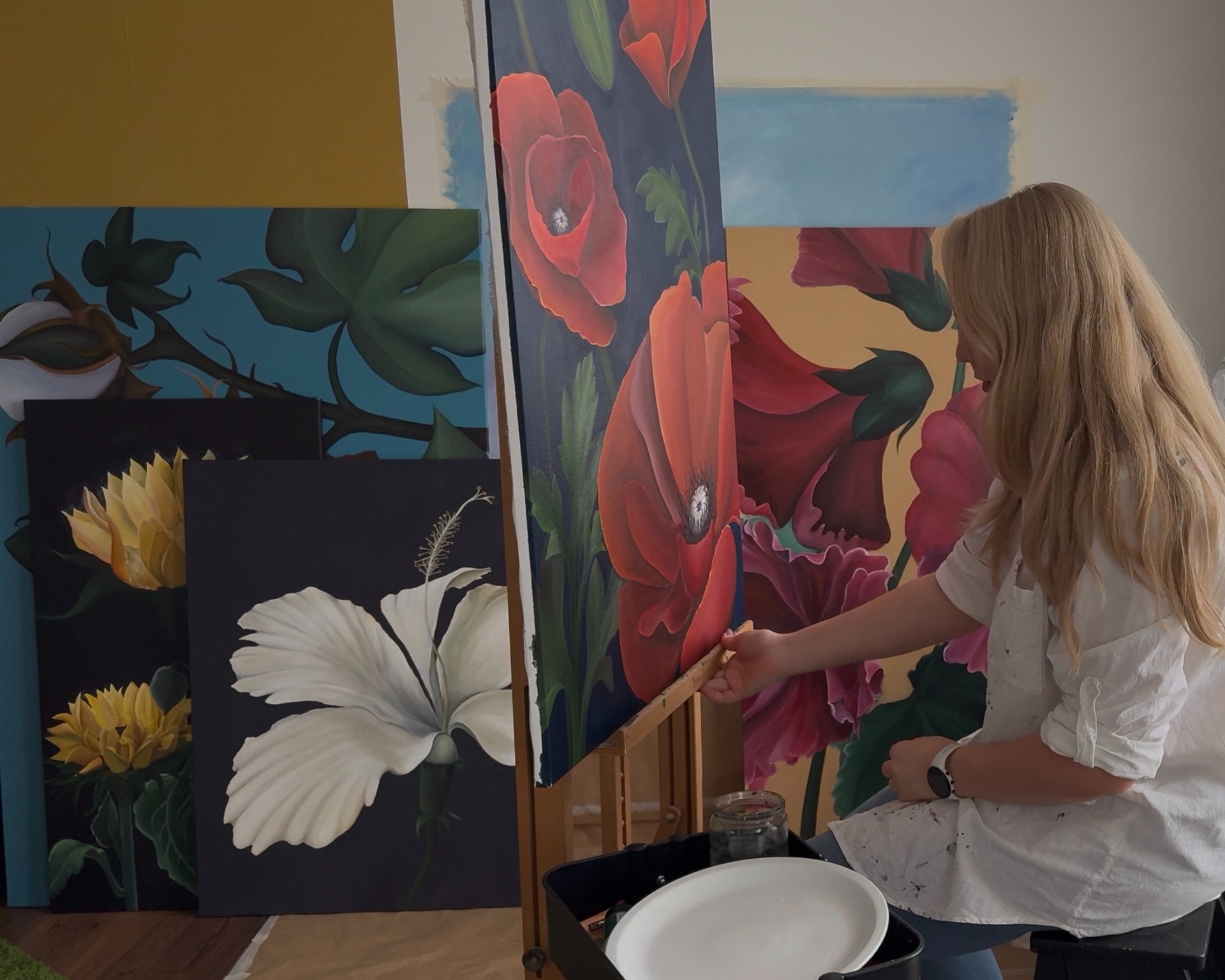
Flowers of Will is a collection defined by resilience — a continuation of Ukrainian culture through art that refuses to fade. Each piece transforms lived pain into a refined form, shaping what was broken into something intentional, elegant, and unmistakably alive. These works do not hide their origins; they give truth structure, presence, and invite a deeper conversation.
For anyone drawn to meaning as much as beauty, each bloom offers more than visual refinement.
It embodies the strength of a culture choosing to rise, and the certainty that its story continues. This collection invites you to welcome art with purpose — and to help carry a cultural voice into the world.
Freedom in Flowers of Will is more than an idea. 20% of profit from the collection is donated to Superhumans Center in Ukraine, helping people affected by the war regain something profoundly tangible: the freedom to move and live independently.
Continue below to meet each piece.


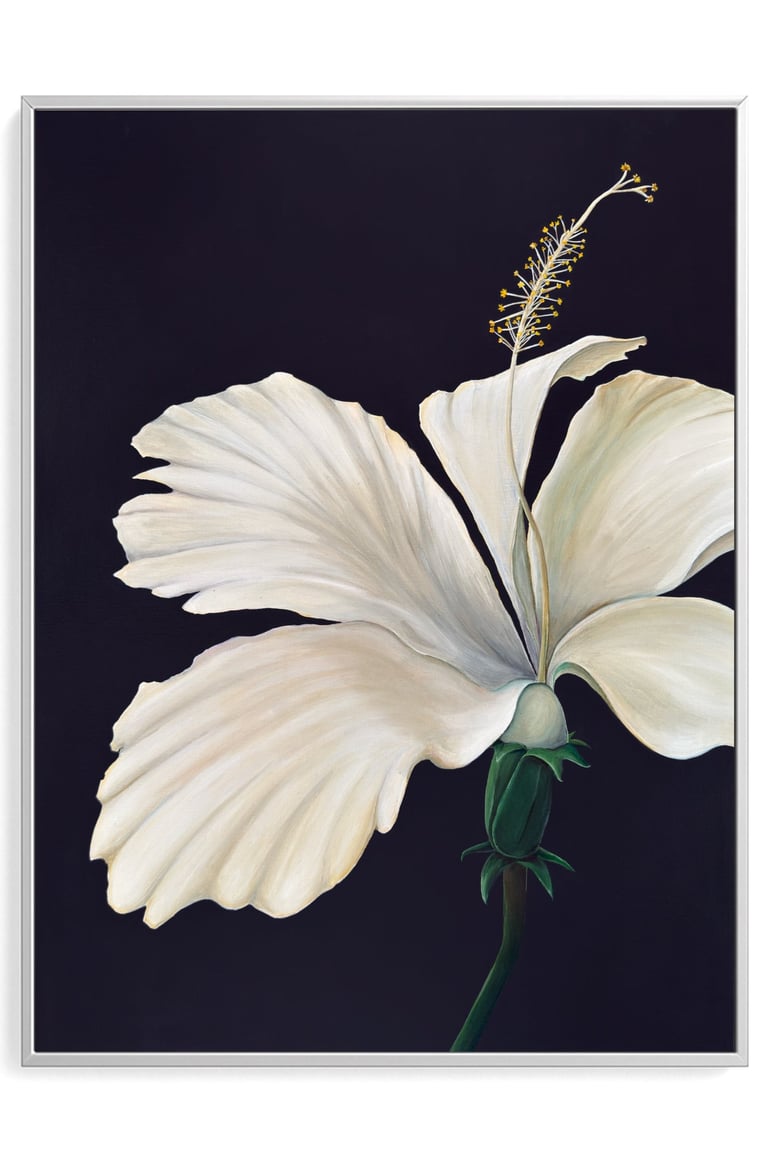
White carries our gentlest meanings — innocence, purity, beginnings. In Ukraine, it also echoes the first white embroidery, winter rituals, and the belief that some things should remain untouched — though history shows how quickly the untouched can be marked.
Innocence, Interrupted reflects that truth quietly.
The white hibiscus stands pure against deep violet, calm at first glance, yet its petals hold faint shadows of everything that tried to change it. Still, it stands. Still, it blooms.
This piece speaks to the quiet strength at the heart of every Ukrainian story — beauty shaped by endurance, tenderness that refuses to fade, identity that grows even as the world shifts.
A reminder that innocence, once interrupted, does not vanish; it transforms. It survives.
Innocence, Interrupted
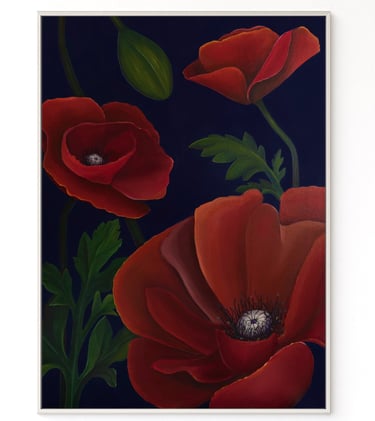
Red has always been the color of remembrance — a symbol carried through poems, fields, and generations. In Ukraine, it holds an even deeper echo: the stories of those who should have returned home, and the quiet strength of the families who continue to hope.
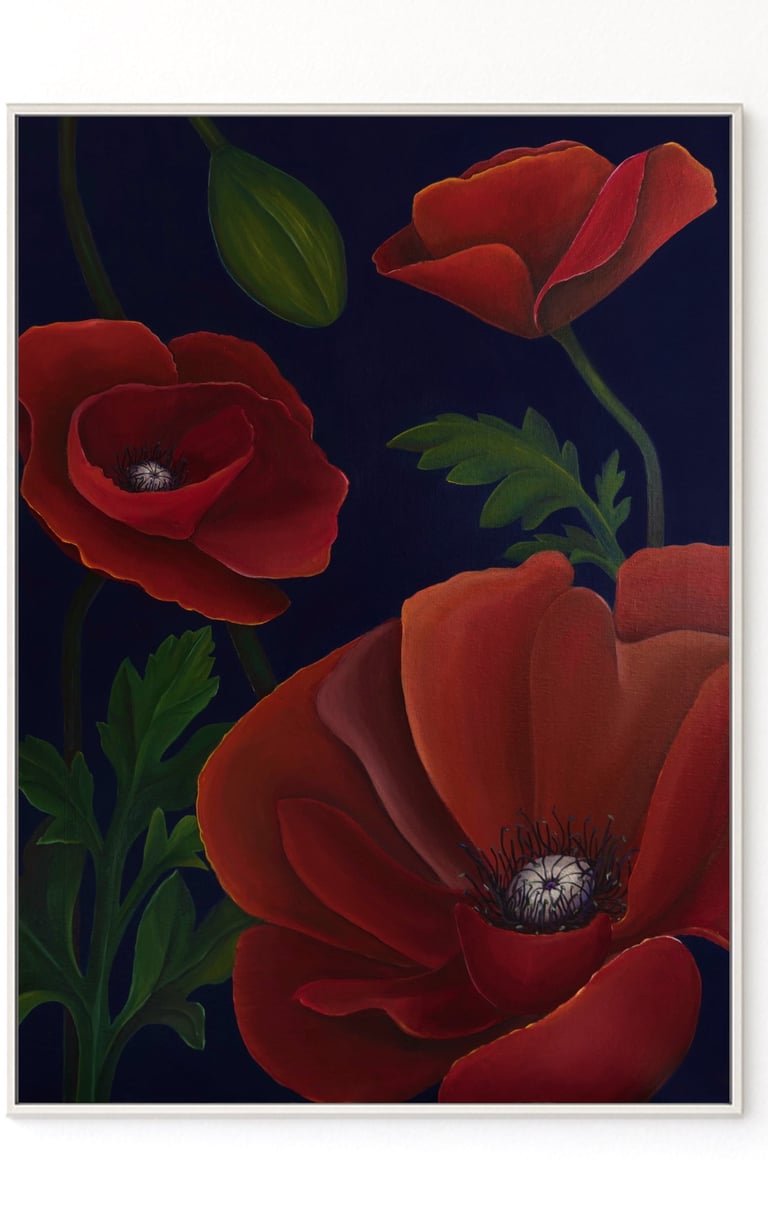
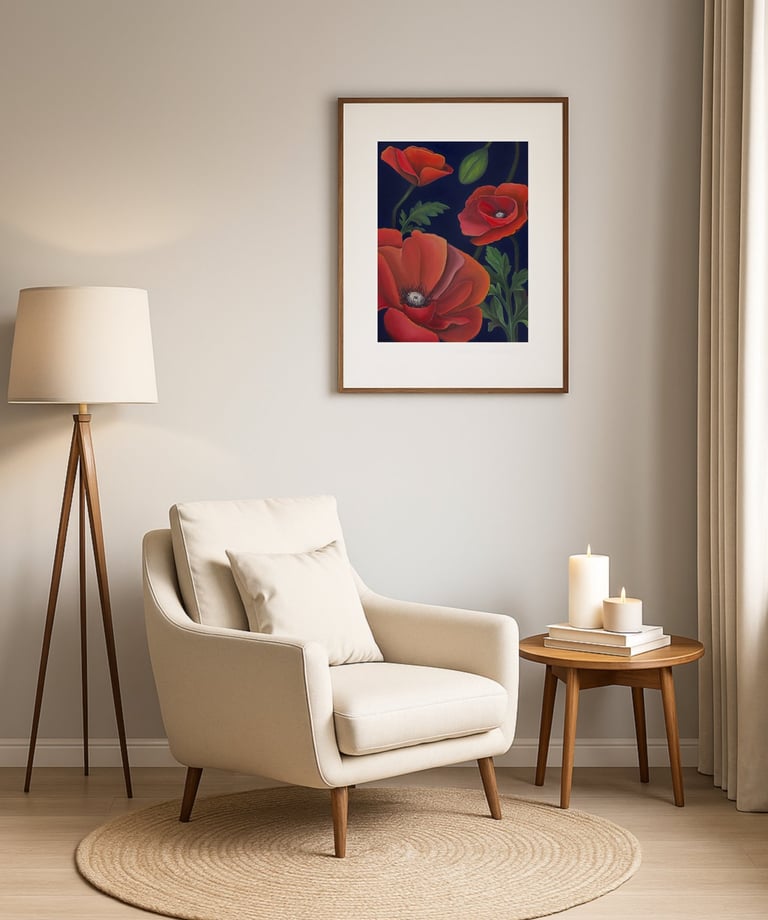
Where Memory Blooms reimagines the red poppy from In Flanders Fields and turns it into something living, vivid, and fiercely present.
The flower’s bright, burning red draws the eye immediately, shifting the poppy from a symbol of loss to one of courage and continuation. Soft petals meet bold color, rising from a deep blue background that gives the bloom a sense of depth and quiet power. This piece honors both memory and resilience — a reminder that even in the hardest seasons, what matters still finds a way to grow.
Because in Ukraine, memory is not the past — it is a living force.
Where Memory Blooms

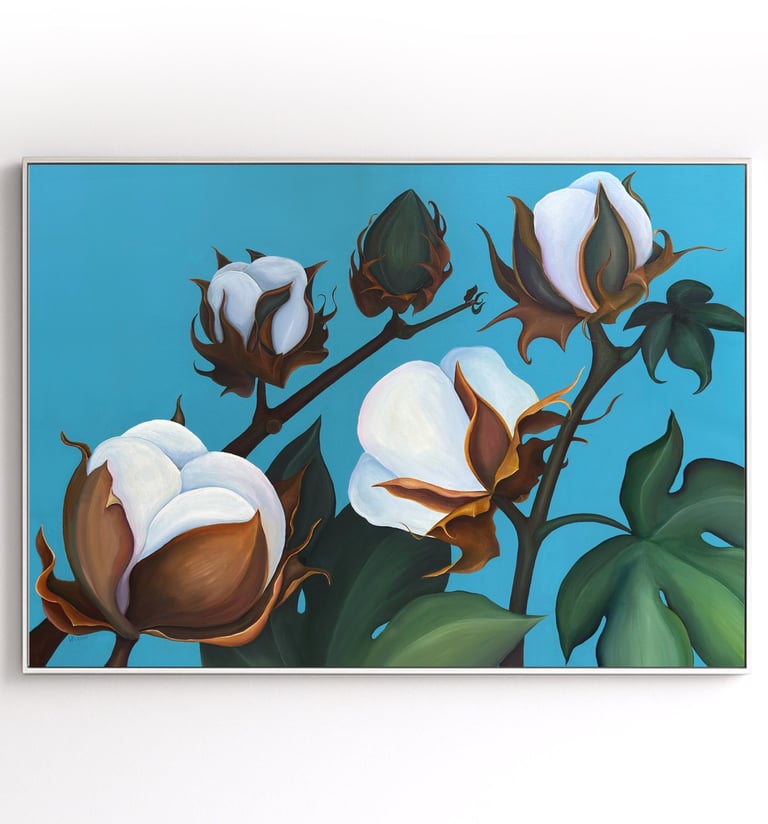
Cotton Sky draws from an earlier moment in the full-scale invasion, when the aggressor's propaganda collapsed under its own absurdity.
Desperate to avoid the word “explosion,” state media chose a euphemism that also means cotton — and once their messaging ran through pseudo-Ukrainian channels, it surfaced as бавовна (cotton). The aggressor's messaging tried so hard to hide reality that it exposed itself.
Ukrainians didn’t soften the lie; they illuminated it: through memes, irony, and the deliberate use of that mistranslated word. But humor was never the point — the truth was, forcing itself through the very language designed to bury it.
This painting carries that rupture: structured, deliberate cotton forms set against an unyielding sky — the visual echo of a distortion that couldn’t survive its own contradiction.
The truth endured, and Ukraine was the one that made it visible.
Cotton Sky
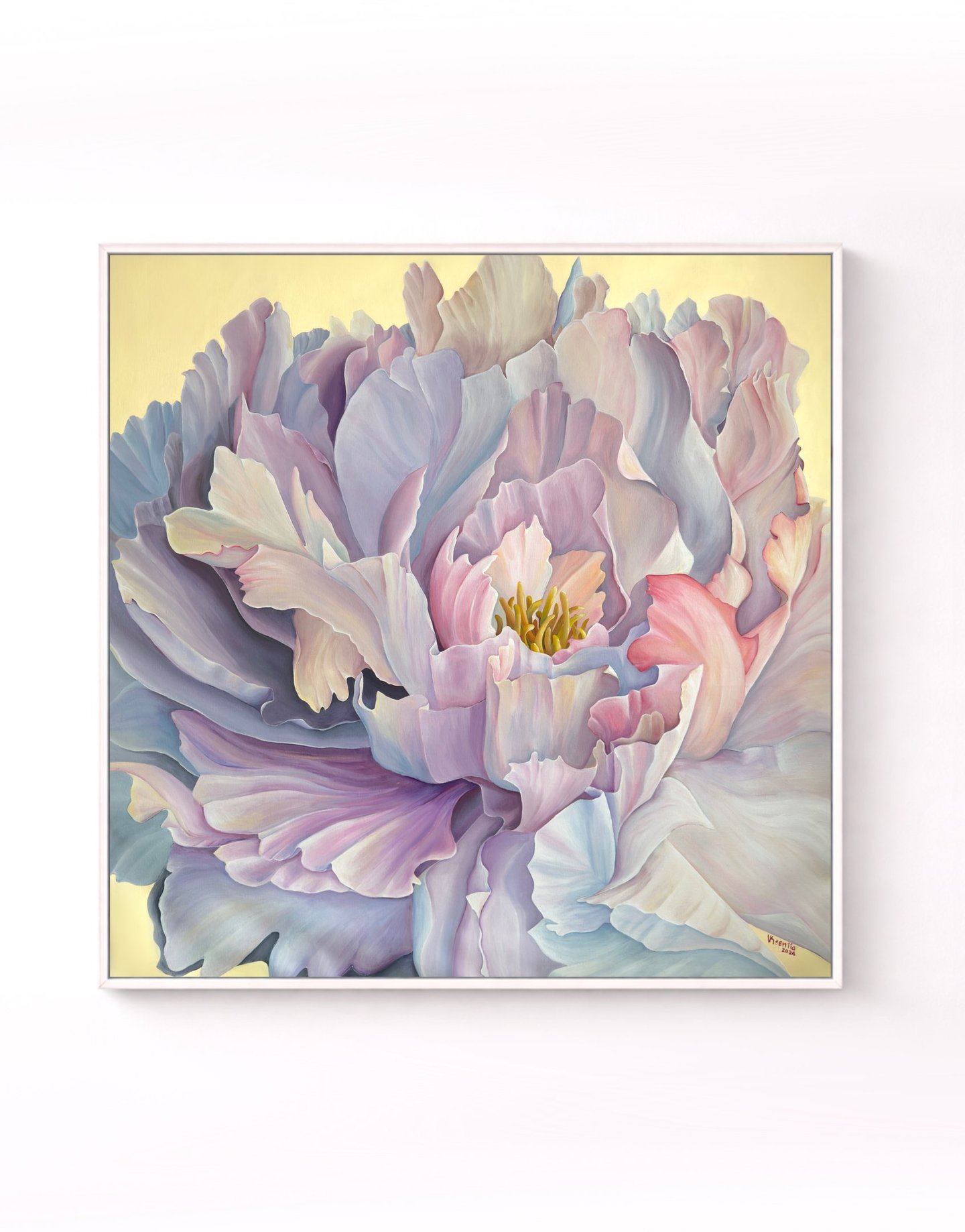
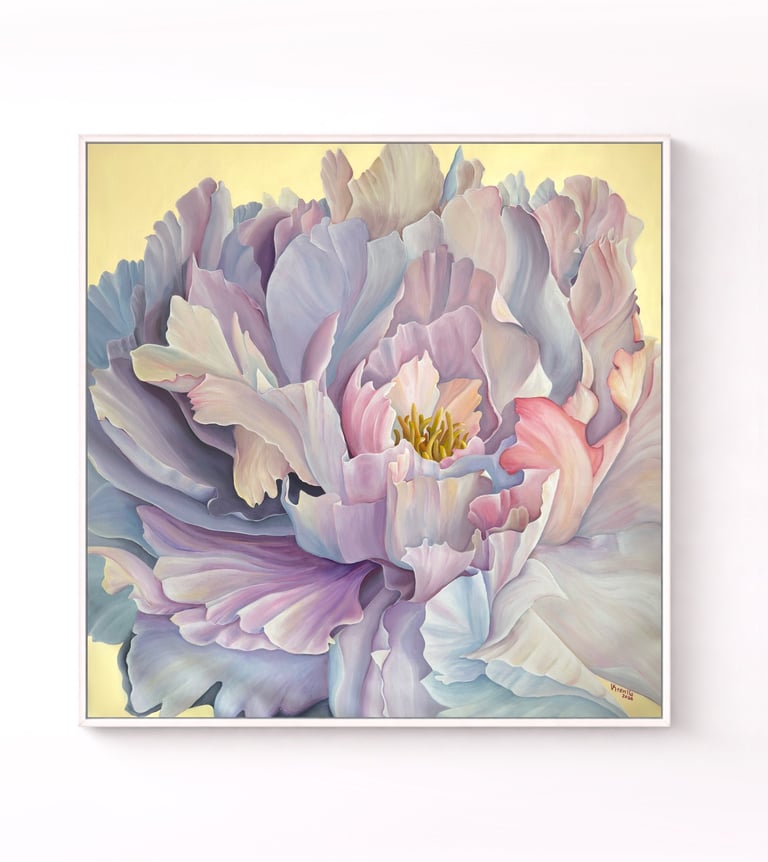
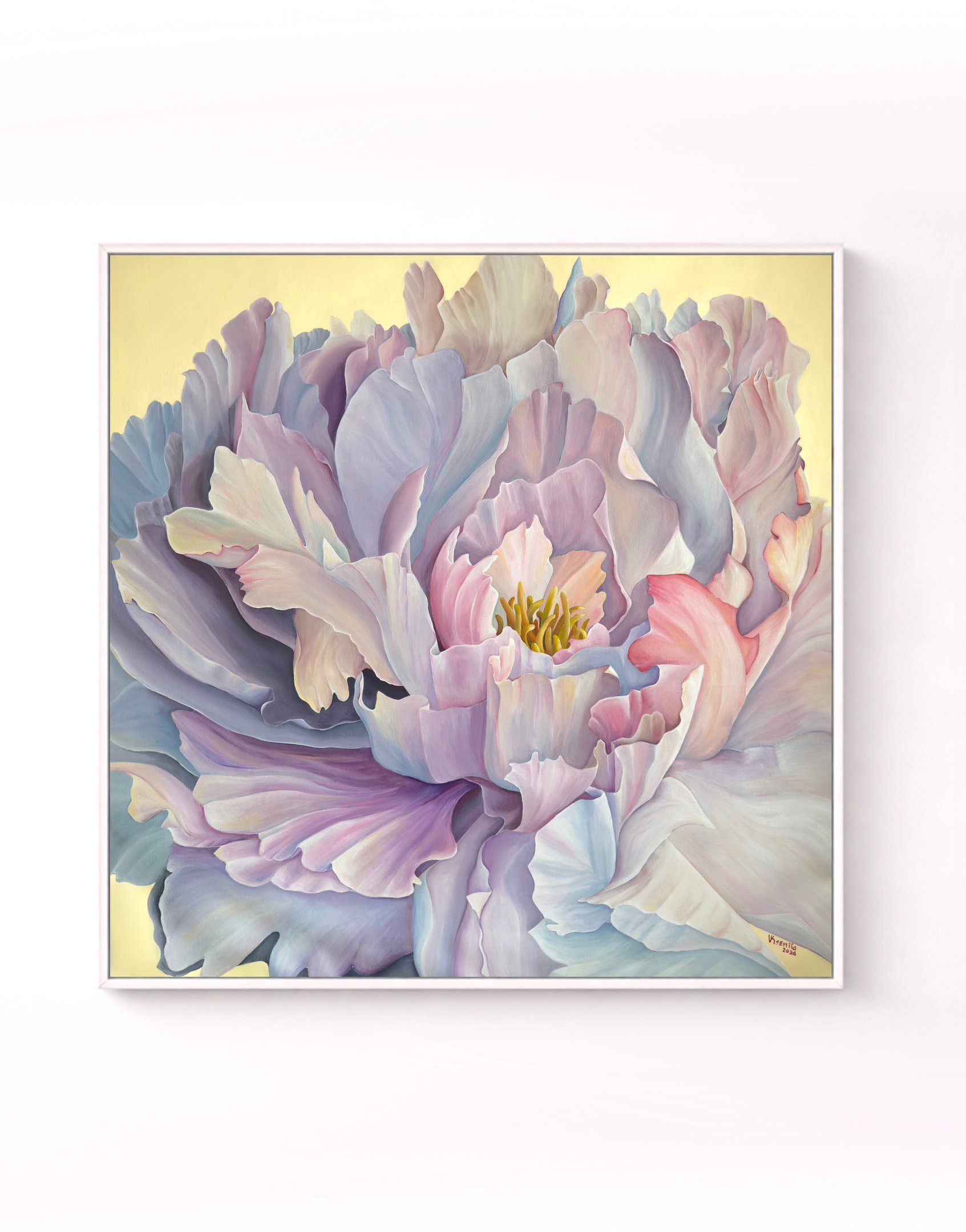
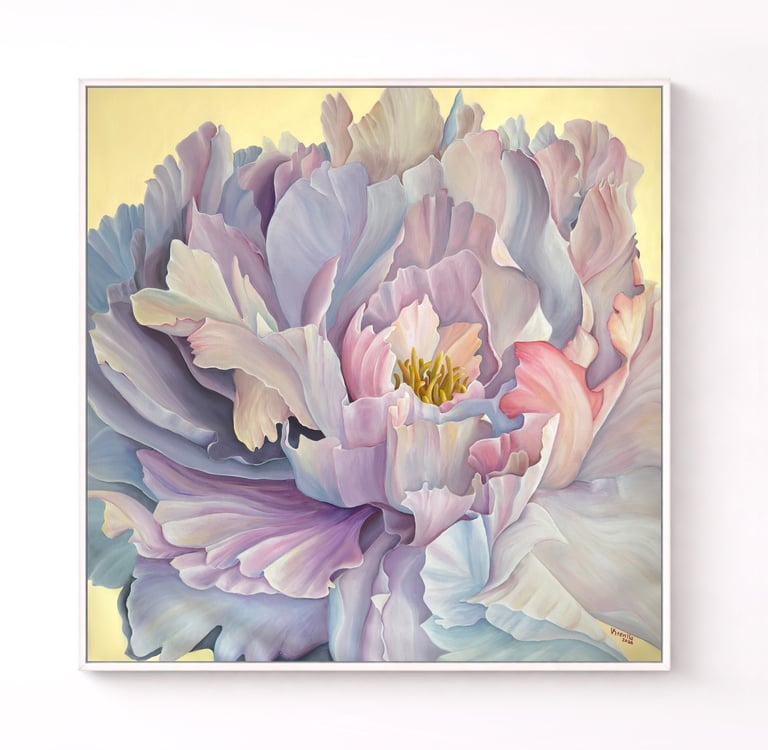
Becoming's story begins with a white peony bush my mother planted at our home in Ukraine. For years, it bloomed the same way, white flowers returned without surprise every year.
Growing up in Ukraine, you learn early that money means safety, and that artists are believed to live without it. This pushed me towards choosing a sensible path, a stable one. I built a business career and a life that looked solid. I learned how to carry expectations without letting them show. How to be reassuring. How not to disappoint.
One spring, the peony bloomed pink. Nothing else around it had changed. The bush grew where it always had. The season arrived as it always did. The flowers opened, and they were pink. People noticed. They talked about it. They were surprised. Some admired it. Then it became part of the garden.
This painting lives in that moment. When something changes because it has reached the point where it can. When no explanation is required, and life makes room for what appears. In the same way, I stepped away from a stable life and allowed art to become the center of mine.
Мала б бути слухняною, але випадково вродила особистістю.
I was supposed to be compliant, but I accidentally bore a personality.
Becoming
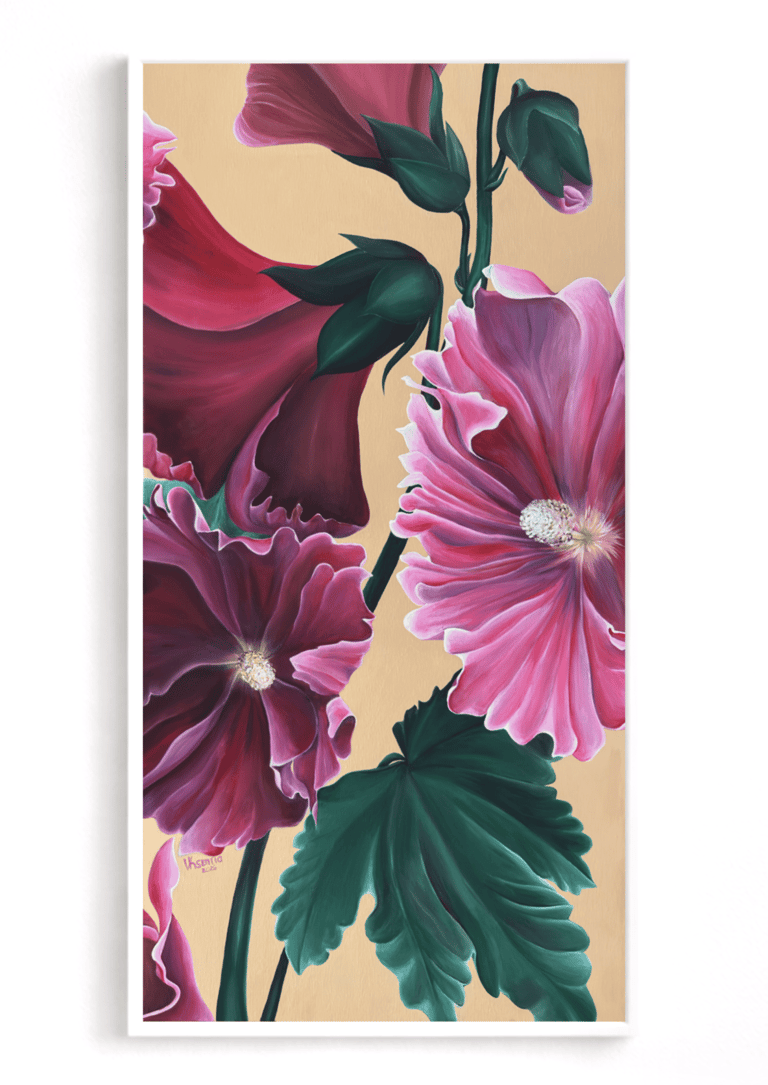
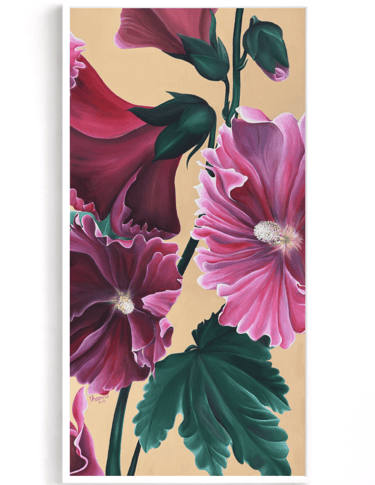
This painting is built on one strong line. A single stem runs through it, dividing the space into two sides. Flowers on the left. Flowers on the right.
The division echoes a national truth: through centuries, Ukraine has been split by empires, front lines, and narratives forced onto us, and even the Dnipro River draws its own line between left bank and right. In modern times, language and religion are weaponized to press that line deeper.
Still, what holds is stronger than what separates.
Malva, the hollyhock, is one of Ukraine’s most tender symbols of belonging. In Ukrainian culture, it is planted by the house as a symbol of protection for the home, roots, and return, a flower kept close to what matters most. In this painting, its meaning expands from one house to an entire homeland.
The same malva blooms on both sides. One stem holds them. One body carries them upward, turning division into backbone, into spine. We are many voices, but in hard moments we become one chorus.
Soborna Ukraine, united, whole, and standing tall.
The Narrow Path
In Ukrainian winters, people have learned to pitch tents inside their own apartments.
This is what an aggressor's missile can do without ever hitting your home.
Strike the infrastructure that keeps a city alive, and electricity disappears, radiators go cold, water stops running.
Resistance does not always look like fighting. Sometimes it looks like cooking dinner on a camp stove. Reading a bedtime story by torchlight. Charging every phone while the sockets work.
There is nothing inspiring about learning how not to freeze in your own home. When ordinary life itself becomes a target, keeping it ordinary becomes an act of refusal. A blackout, however long, carries the possibility of an ending. Eventually, the power comes back.
Not everything war takes does.
You see two sunflowers in front of you. An incomplete family among the countless Ukrainian families from which war has taken a husband, a father, a son, a brother. Some darkness has nothing to do with electricity.
Dinner still needs a table — now set for two. A child still needs a goodnight — but only one voice is there to say it. The phone is charged — but the most-called number will never answer again.
The person left behind carries their own darkness. And still, someone smaller looks to them for light. Strength is sometimes having no light to spare, and finding some to give anyway.
Russia can leave Ukraine without electricity. It cannot leave it without light.
Light


There is a moment when standing your ground stops being about courage and becomes a question: what behind you matters enough not to move?
In Balaclava, Crimea, a thin Scottish red line once stood against a Russian advance. More than a century and a half later, Ukrainians are still standing between a Russian advance and the places they call home. Russia had annexed Crimea before. In 2014, it did so again.
Nobody holds a line for the line itself. You hold it for what's behind you. Ask the Ukrainian soldiers who've been doing this since 2014. A cracked phone screen with a kid's photo on it. A father who enlisted next to his two grown sons because none of them could stand being apart more than they could stand the war. A call that cuts out mid-word and buys you twenty minutes of assuming the worst, staring at a black screen that has nothing to say back. Then it rings, and you realize how much of you had already started saying goodbye.
People keep calling this bravery. "Be brave like Ukraine". Maybe from far away it looks like that. Up close, it is something more intimate.
It is love. For the people behind you. For your family. Your language and culture. The place that made you who you are.
Balaclava lasted one afternoon. Ukraine has been holding its line for twelve years. Twelve years is what love actually looks like when nobody's filming it anymore.
Thin Red Line


Borysthenes is the ancient Greek name for the Dnipro.
More than two thousand years later, the name still lives in Stipa borysthenica — Dnipro feather grass, a vulnerable species carrying the river in its name and the Ukrainian steppe in its roots.
When feather grass takes the wind, thousands of fine heads bend together and the steppe ripples like water.
There is a cruel poetry in that resemblance. On 6 June 2023, the destruction of the Kakhovka Dam unleashed water across more than 600 square kilometres, redrawing in hours a landscape centuries in the making. `The United Nations concluded that much of the environmental damage is irreversible.
We have learned to count the cost of war in human lives, destroyed homes and displaced families. We are less practiced at counting everything else that disappears with them. But how do you count the lives that leave no bodies — a species, a habitat, an ecosystem erased?
Cities can be rebuilt. An ecosystem cannot.
This, too, is Russia's war against Ukraine: not only against its people, language and culture, but against the living world they belong to.
For centuries, water sustained this landscape. In human hands, it became the force that transformed it in a single night.
Uncounted


Newsletter sign-up
© 2026 KSENIIA